Technical hotline and customer support software: why phone-only holds back your growth
Overloaded hotline, overstretched teams, knowledge walking out the door. Why modern customer support software is a growth lever for OEMs and distributors.

In most industrial companies and among distributors of technical equipment, customer support has barely changed over the past twenty years. A phone switchboard. A handful of front-line technicians. Spreadsheets to track cases. Maybe some ticketing filled in by hand. And behind them, two or three technical referents everyone calls because they are the team’s memory and its good souls.
Meanwhile, volumes have tripled, products have grown more complex, the talent pool has dried up, and export has become a growth driver with globalization—which also intensifies competitive pressure. The system that more or less worked in 2010 is straining everywhere in 2026.
Customer support can no longer be treated as a cost centre. It is a strategic asset to build and monetize. The software that orchestrates it shapes the company’s trajectory, its ability to absorb growth, its margins, and its competitive edge. In 2026, choosing technical hotline software and customer support software is no longer about picking a few ticketing tools. It is about defining a self-improving architecture that connects communication channels with artificial intelligence, so every interaction becomes either a billable operation or an investment in competitive advantage (brand positioning, knowledge capital).
This article outlines five issues that elevate support to a strategic decision, warns about the risks of certain technology paths, and describes the concrete architecture that turns an overloaded hotline into a growth lever.
Five issues that make customer support strategic
Support as a brake—or an accelerator—for growth
As long as a hotline is neither structured nor parallelizable, every new signed customer weighs on the organization and the cost base. Sales closes deals, after-sales chokes, and growth is paid for in degraded service quality, then staff turnover, and finally customer churn. Many leadership teams spot the problem too late—when NPS drops and renewals slow. The only lever left is hiring, in the middle of a labour shortage.
Support that scales changes the equation. It becomes a demonstrable sales argument, not just marketing copy. It gives the organization options beyond endless recruitment. It turns volume growth into a competitive advantage instead of a permanent operational risk.
The shortage of qualified technical profiles
Hiring a hotliner who can diagnose a fault on a side-loader, a hydraulic winch, a primary packaging machine, or a powered wheelchair is an uphill battle. Schools don’t train for these roles. The best people are already with competitors or partners. Onboarding means months of mentorship. Retirements take decades of know-how that no document ever captured. Staffing a technical support team in 2026 can take two years. Hiring costs are far higher than five years ago, and the trend is worsening.
Relying on recruitment alone as your adjustment variable is no longer viable.
Chronic overload of technical referents
In every company, teams (as well as partners, customers, and even suppliers) know which two or three people to reach when a case is complex. Those people are interrupted non-stop by questions that mostly do not need their level of expertise. Their calendars disappear under repetitive requests. The direct cost is longer resolution times on the cases that truly need them. The indirect cost—more insidious—is burnout and disengagement among scarce experts. When a technical referent leaves, you are not filling a seat—you are closing a library. A strategic asset vanishes.
Service as differentiation and margin
On globalized markets where products commoditize quickly, in an increasingly uncertain economy, service is what remains to stand out and stay close to customers—if you can deliver it, measure it, and bill for it. Structured customer support produces the data that turns subsidized service into sold service. Premium maintenance contracts backed by a met SLA. Priority support subscriptions. Extended warranties. Access to intelligent assistants for end users. All of that requires infrastructure that traces, qualifies, capitalizes, and retrieves. Without it, service stays a buried cost in the P&L. With it, it becomes recurring revenue and iterative investment.
Export and the 24/7 multilingual constraint
International growth immediately raises two operational locks. The first is time. A customer in Singapore, Dubai, or Mexico cannot wait for the office to open in France, Germany, or Italy to report a production stop. The second is language. Expecting a German, Polish, or Brazilian customer to describe a technical fault in French or English creates friction and injects diagnostic bias that damages the relationship long term. Many companies have patched these issues with partial outsourcing abroad, exhausting on-call phone duty, outsourced hotlines manually retyping requests into tickets, ad-hoc translators, or giving up on serving some markets properly. None of these answers scales as export share grows. Technical support built around a multilingual AI layer available 24/7 changes the game. First-line issues are handled in the customer’s language at any hour; only cases that justify it escalate to human teams during business hours. For export-focused businesses, that is not a nice-to-have—it is a market access condition.
Phone-only cannot carry the load
The phone switchboard has a structural trait that is too often forgotten: it is serial. One call ties up one technician for the entire interaction, regardless of topic complexity or urgency. Meanwhile, other customers wait in queue. The hotliner cannot parallelize cases or prioritize cleanly. They may dispatch by specialty, but the same structural limit applies to referents, workshop leads, and design-office engineers. The channel absorbs the flow, first-come-first-served, peaks, seasonality.
Every after-sales director knows the outcome. Queues lengthen, frustrated customers call two or three times for the same issue, teams live in permanent firefighting, and nothing is capitalized because nothing is traced.
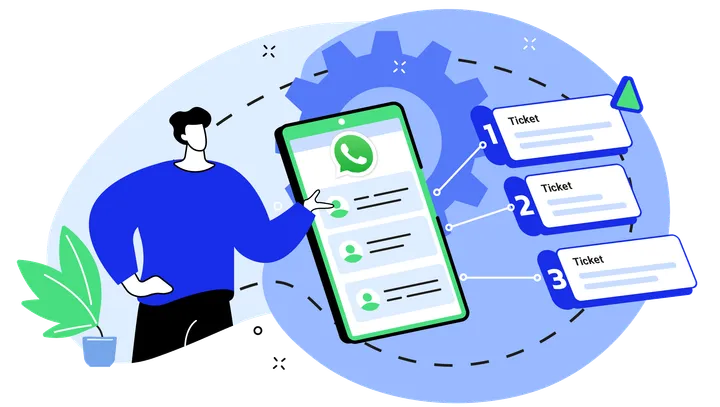
Adding a written step upstream removes this lock without breaking proximity. The customer submits via email, WhatsApp, or web chat. The system qualifies, routes, offers an immediate answer when possible, or opens a prioritized ticket for escalation. Phone and video come second, deliberately, for cases that truly need them. That is not weakening the relationship—it is structuring and professionalizing it. The customer is reassured because they know they are in the loop at every step, for a better experience.
Why voice AI is not yet the answer for technical hotlines
A misleading idea is circulating: voice AI on the phone would be the obvious next step for support. On paper it is seductive—technology is improving fast, demos impress, and marginal cost per conversation trends toward zero. For technical topics, the equation differs.
Voice AI is relevant today for bounded use cases. Appointment booking. Simple commercial qualification. Confirming transactional information. For a technical hotline it remains risky. Speech recognition still errs on sector-specific jargon, alphanumeric product references, and fault codes. Latency makes conversations jerky, alienates customers, and blocks adoption. Above all, legal and operational risk is real. When a fault worsens because synthetic voice misstated information and led the customer to the wrong action, who owns that? The cost of one such mistake far outweighs hoped-for productivity gains.
Voice AI may reach technical hotlines in a few years, when companies have adopted and tuned models on their own data and vocabularies, and latency has dropped. For now, the best strategy is not to bet on it.
Written AI is mature enough to absorb level 1
That is precisely where the shift has already happened—often unnoticed. Written AI grounded in a domain corpus is mature. It pre-qualifies inbound requests by extracting useful signals. It answers recurring questions with high accuracy. It dispatches to the right expert when escalation is required. It runs multilingual, 24/7, on every written channel customers already use: email, WhatsApp, web chat.
One number to compare with your own activity: among the customers we support, 15 to 30% of inbound contacts are recurring questions. Misread user manual. Commissioning procedure. Standard spare-part request. Accessory compatibility question. When a senior technician has answered once, they should never answer again. That simple rule, embedded in customer support software, immediately frees bandwidth.
The same logic applies to industrial OEMs and distributors of technical equipment aimed at professionals and demanding consumers: outdoor power equipment, e-mobility gear, professional tools, high-end commercial coffee machines, advanced home robotics, marine equipment, measuring instruments, professional kitchen equipment, HVAC. In these worlds, recurring questions often exceed 30%. Seasonal spikes add pressure that only written AI can absorb without hiring.
For general management in small and medium structures, the issue hits even harder. Customer support grows fast, resources are finite, and every hour spent on true level-1 questions is an hour not spent on product development, installation, repair, or sales.
When the customer cannot write: field use cases
A fair objection: written channels work when the customer has free hands. Many technical hotline contacts come from people whose hands are full—or dirty. The driver in the cab of a machine blocking a street. The HVAC installer on a roof or in a lift during a scheduled job. The pumping-station technician in a cramped room with gloves on. The electrician in front of a panel. The refrigeration tech under the unit. None of them will open email or type a ticket on the spot.
Writing does not exclude these situations—it absorbs them through three complementary mechanisms. First, voice becomes a natural on-ramp to text. A voice note sent on WhatsApp is transcribed automatically, processed by level-1 AI like any text request, and the reply returns as voice or text depending on context. The customer typed nothing, yet the written pipeline handled it. Second, human relay still filters. The site lead, installation supervisor, or site manager remain the official first contact with support, as with phone. The difference is they now use a channel that traces, qualifies, and capitalizes. Finally, when seeing is understanding, switching to remote video from the ticket takes two clicks—which leads to the next point.
For distributors and OEMs with large mobile user populations, this is not a detail—it is a selection criterion.
Remote video assistance for the 10–15% of cases that weigh the heaviest
Another category needs a dedicated answer: when remote support hits a vocabulary gap between customer and hotliner. That gap exists in every setup; it is amplified in technical and international contexts. Describing over the phone a leak, an abnormal vibration, an indicator light whose exact colour the customer cannot name, a misaligned assembly is asking a non-expert to pre-diagnose using words they do not master. The hotliner guesses, rephrases, proposes hypotheses, asks for detail—in short, gropes. Time passes. Often, without remote conclusion, a site visit is triggered—only to find that fifteen minutes at a distance would have sufficed.
Remote video assistance solves this by nature. See the machine. Point at the part on screen. Show the gesture. Annotate live what the customer must watch or handle. On cases we have measured with customers, resolution time drops 50–80% on the most complex issues, and the majority of trips driven by misunderstanding disappear. That bucket is 10–15% of inbound volume but a far larger share of total support cost.
Real-time translation of exchanges strengthens the model for international work. A French OEM guiding a partner technician in Vietnam on a machine installed for a Japanese end customer can run the intervention without imposing a common language. Each participant speaks and writes in their own language. The system translates live, with up to twenty participants simultaneously.
Turning knowledge into an asset that grows: the capitalization flywheel
Previous sections describe operational levers. None suffices alone. What differentiates next-generation customer support software from a pile of tools is the loop it installs between interactions and organizational memory.
While knowledge lives only in referents’ heads, the company pays three times: once when the hotliner wastes time digging through file servers they barely understand, again in referent overload, and a third time in critical dependency when people leave.
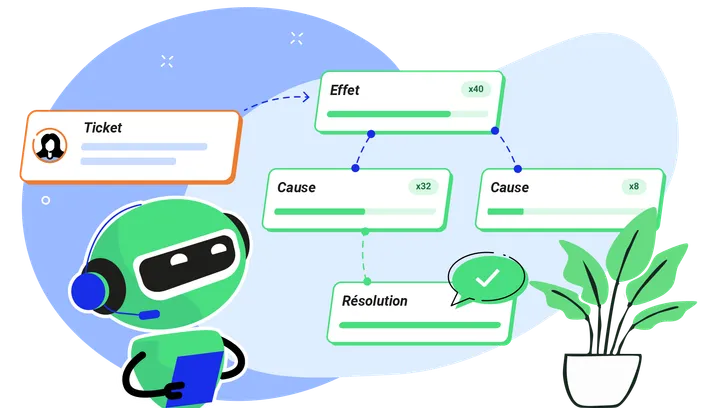
The logic flips when software turns every interaction into usable capital. Intervention reports draft automatically from exchanges, without extra burden on teams. After review, each closed case enriches a searchable operational memory. That memory feeds AI assistants by audience—end customer, partner, or internal. The internal assistant helps hotliners instantly find relevant information from similar past cases. Partner and customer assistants answer recurring questions with accuracy that improves over time.
The loop closes. The more the system runs, the more precise it becomes. The more precise it becomes, the more level 1 it absorbs. The more level 1 it absorbs, the freer referents are for truly complex cases. The more those cases are resolved with clean traces, the larger memory grows. At FIXEE we call this the virtuous circle of capitalization and activation of knowledge through operations.
That mechanic inverts the usual relationship to support. Time is no longer an enemy eroding know-how—it becomes an ally that consolidates it.
What technical hotline and customer support software must cover in 2026
At this point the requirements list becomes easier to state. Serious customer support software in 2026 should cover a non-negotiable baseline:
- A centralized multichannel contact point with semi-automated ticketing on email, WhatsApp, and web chat
- A level-1 customer AI assistant that can pre-qualify, answer frequent questions, and dispatch—multilingual, 24/7
- Integrated remote video assistance when verbal description is not enough
- Real-time translation of exchanges among everyone involved in an intervention, including multichannel
- Automatic drafting of intervention reports to feed team memory without extra workload
- An intelligent assistant for hotliners to query report history and all internal documentation
- The ability to measure and expose the value of service delivered, to turn it into billable assets
That is exactly the functional coverage FIXEE proposes for industrial OEMs and distributors of technical equipment. Coherence of the whole is not a detail—it is what installs the virtuous circle. Stacking three or four partial solutions does not reproduce that coherence. It adds more silos.
From bottleneck to growth lever
Today’s technical hotline is neither an endlessly hiring phone bank, nor a synthetic voice pretending to be a technician, nor an isolated chatbot on a website. It is orchestration of written and voice channels on top of a knowledge base that grows with every intervention.
For industrial OEMs, distributors of technical equipment, and leadership teams who have made service a strategic pillar, the question is no longer whether to invest. It is choosing an architecture that lasts, scales with growth, and turns support into a lever instead of a bottleneck.
If you lead a support, after-sales, or customer service team and want an honest assessment of your current setup, FIXEE offers a 15-minute diagnostic. No commitment, no disguised product demo—just a straightforward read of your weak spots and the levers to pull first.
About the author
FIXEE